What is time? Rather than something that ‘flows,’ a philosopher suggests time is a psychological projection
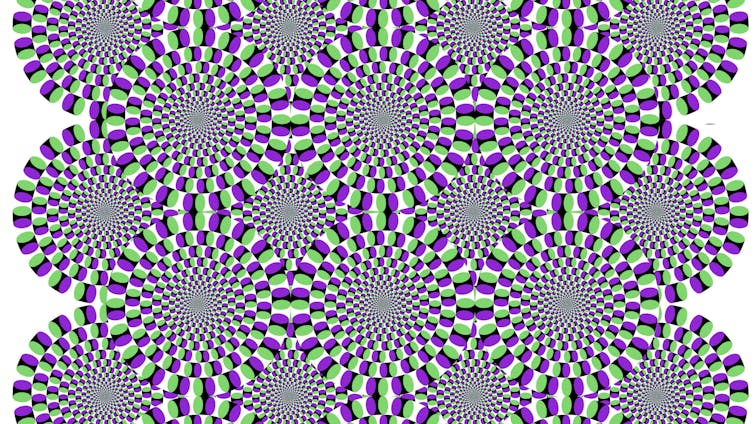
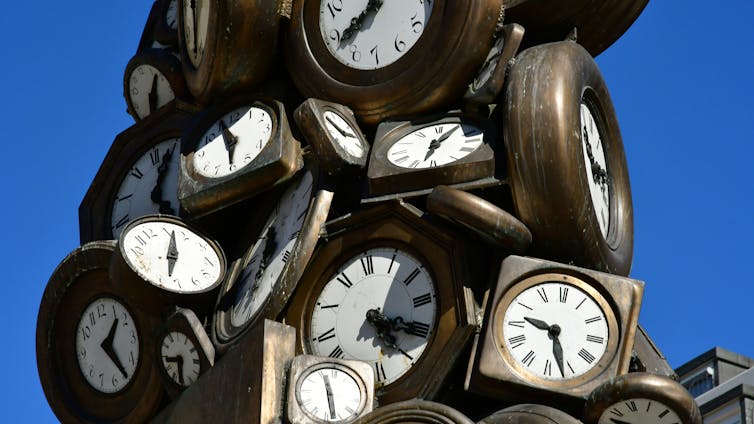
Time isn’t an illusion, unlike optical illusions that trick your eyes. There’s nothing to ‘trick’ because it has no physical basis. BSIP/UIG Via Getty Image
“Time flies,” “time waits for no one,” “as time goes on”: The way we speak about time tends to strongly imply that the passage of time is some sort of real process that happens out there in the world. We inhabit the present moment and move through time, even as events come and go, fading into the past.
But go ahead and try to actually verbalize just what is meant by the flow or passage of time. A flow of what? Rivers flow because water is in motion. What does it mean to say that time flows?
Events are more like happenings than things, yet we talk as though they have ever-changing locations in the future, present or past. But if some events are future, and moving toward you, and some past, moving away, then where are they? The future and past don’t seem to have any physical location.
Human beings have been thinking about time for as long as we have records of humans thinking about anything at all. The concept of time inescapably permeates every single thought you have about yourself and the world around you. That’s why, as a philosopher, philosophical and scientific developments in our understanding of time have always seemed especially important to me.
Ancient philosophers were very suspicious about the whole idea of time and change. Parmenides of Elea was a Greek philosopher of the sixth to fifth centuries BCE. Parmenides wondered, if the future is not yet and the past is not anymore, how could events pass from future to present to past?
He reasoned that, if the future is real, then it is real now; and, if what is real now is only what is present, the future is not real. So, if the future is not real, then the occurrence of any present event is a case of something inexplicably coming from nothing.
Parmenides wasn’t the only skeptic about time. Similar reasoning regarding contradictions inherent in the way we talk about time appears in Aristotle, in the ancient Hindu school known as the Advaita Vedanta and in the work of Augustine of Hippo, also known as St. Augustine, just to name a few.
Einstein and relativity
The early modern physicist Isaac Newton had presumed an unperceived yet real flow of time. To Newton, time is a dynamic physical phenomenon that exists in the background, a regular, ticking universe-clock in terms of which one can objectively describe all motions and accelerations.
Then, Albert Einstein came along.
In 1905 and 1915, Einstein proposed his special and general theories of relativity, respectively. These theories validated all those long-running suspicions about the very concept of time and change.
Relativity rejects Newton’s notion about time as a universal physical phenomenon.
By Einstein’s era, researchers had shown that the speed of light is a constant, regardless of the velocity of the source. To take this fact seriously, he argued, is to take all object velocities to be relative.
Nothing is ever really at rest or really in motion; it all depends on your “frame of reference.” A frame of reference determines the spatial and temporal coordinates a given observer will assign to objects and events, on the assumption that he or she is at rest relative to everything else.
Someone floating in space sees a spaceship going by to the right. But the universe itself is completely neutral on whether the observer is at rest and the ship is moving to the right, or if the ship is at rest with the observer moving to the left.
This notion affects our understanding of what clocks actually do. Because the speed of light is a constant, two observers moving relative to each other will assign different times to different events.
In a famous example, two equidistant lightning strikes occur simultaneously for an observer at a train station who can see both at once. An observer on the train, moving toward one lightning strike and away from the other, will assign different times to the strikes. This is because one observer is moving away from the light coming from one strike and toward the light coming from the other. The other observer is stationary relative to the lightning strikes, so the respective light from each reaches him at the same time. Neither is right or wrong.
In a famous example of relativity, observers assign different times to two lightning strikes happening simultaneously.
How much time elapses between events, and what time something happens, depends on the observer’s frame of reference. Observers moving relative to each other will, at any given moment, disagree on what events are happening now; events that are happening now according to one observer’s reckoning at any given moment will lie in the future for another observer, and so on.
Under relativity, all times are equally real. Everything that has ever happened or ever will happen is happening now for a hypothetical observer. There are no events that are either merely potential or a mere memory. There is no single, absolute, universal present, and thus there is no flow of time as events supposedly “become” present.
Change just means that the situation is different at different times. At any moment, I remember certain things. At later moments, I remember more. That’s all there is to the passage of time. This doctrine, widely accepted today among both physicists and philosophers, is known as “eternalism”.
This brings us to a pivotal question: If there is no such thing as the passage of time, why does everyone seem to think that there is?
Time as a psychological projection
One common option has been to suggest that the passage of time is an “illusion” – exactly as Einstein famously described it at one point.
Calling the passage of time “illusory” misleadingly suggests that our belief in the passage of time is a result of misperception, as though it were some sort of optical illusion. But I think it’s more accurate to think of this belief as resulting from misconception.
As I propose in my book “A Brief History of the Philosophy of Time,” our sense of the passage of time is an example of psychological projection – a type of cognitive error that involves misconceiving the nature of your own experience.
The classic example is color. A red rose is not really red, per se. Rather, the rose reflects light at a certain wavelength, and a visual experience of this wavelength may give rise to a feeling of redness. My point is that the rose is neither really red nor does it convey the illusion of redness.
The red visual experience is just a matter of how we process objectively true facts about the rose. It’s not a mistake to identify a rose by its redness; the rose enthusiast isn’t making a deep claim about the nature of color itself.
Similarly, my research suggests that the passage of time is neither real nor an illusion: It’s a projection based on how people make sense of the world. I can’t really describe the world without the passage of time any more than I can describe my visual experience of the world without referencing the color of objects.
I can say that my GPS “thinks” I took a wrong turn without really committing myself to my GPS being a conscious, thinking being. My GPS has no mind, and thus no mental map of the world, yet I am not wrong in understanding its output as a valid representation of my location and my destination.
Similarly, even though physics leaves no room for the dynamic passage of time, time is effectively dynamic to me as far as my experience of the world is concerned.
The passage of time is inextricably bound up with how humans represent our own experiences. Our picture of the world is inseparable from the conditions under which we, as perceivers and thinkers, experience and understand the world. Any description of reality we come up with will unavoidably be infused with our perspective. The error lies in confusing our perspective on reality with reality itself.
Physicists and philosophers have long struggled to understand the nature of time: Here’s why
Time itself isn’t difficult to grasp: we all understand it, despite our persistent struggle to describe it. The problem is one of articulation: a failure to precisely draw the right boundaries around the nature of time both conceptually and linguistically. (Donald Wu/Unsplash), CC BY
The nature of time has plagued thinkers for as long as we’ve tried to understand the world we live in. Intuitively, we know what time is, but try to explain it, and we end up tying our minds in knots.
St. Augustine of Hippo, a theologian whose writings influenced western philosophy, captured a paradoxical challenge in trying to articulate time more than 1,600 years ago:
“What then is time? If no one asks me, I know; if I want to explain it to a questioner, I do not know.”
Nearly a thousand years earlier, Heraclitus of Ephesus offered a penetrating insight. According to classical Greek philosopher Plato’s Cratylus:
“Heraclitus is supposed to say that all things are in motion and nothing at rest; he compares them to the stream of a river, and says that you cannot go into the same water twice.”
Superficially, this can sound like another paradox — how can something be the same river and yet not the same? But Heraclitus adds clarity, not confusion: the river — a thing that exists — continuously changes. While it is the same river, different waters flow by moment to moment.
While the river’s continuous flux makes this plain, the same is true of anything that exists — including the person stepping into the river. They remain the same person, but each moment they set foot in the river is distinct.
The key issue isn’t one most physicists would even consider relevant. Nor is it a challenge that philosophers have managed to resolve.
Time itself isn’t difficult to grasp: we all understand it, despite our persistent struggle to describe it. As Augustine sensed, the problem is one of articulation: a failure to precisely draw the right boundaries around the nature of time both conceptually and linguistically.
Specifically, physicists and philosophers tend to conflate what it means for something to exist and what it means for something to happen — treating occurrences as if they exist. Once that distinction is recognized, the fog clears and Augustine’s paradox dissolves.
The source of the issue
In basic logic, there are no true paradoxes, only deductions that rest on subtly mishandled premises.
Not long after Heraclitus tried to clarify time, Parmenides of Elea did the opposite. His deduction begins with a seemingly valid premise — “what is, is; and what is not, is not” — and then quietly smuggles in a crucial assumption. He claims the past is part of reality because it has been experienced, and the future must also belong to reality because we anticipate it.
Therefore, Parmenides concluded, both past and future are part of “what is,” and all of eternity must form a single continuous whole in which time is an illusion.
Parmenides’ pupil, Zeno, devised several paradoxes to support this view. In modern terms, Zeno would argue that if you tried walking from one end of a block to the other, you’d never get there. To walk a block, you must first walk half, then half of what remains, and so on — always halving the remaining distance, never reaching the end.
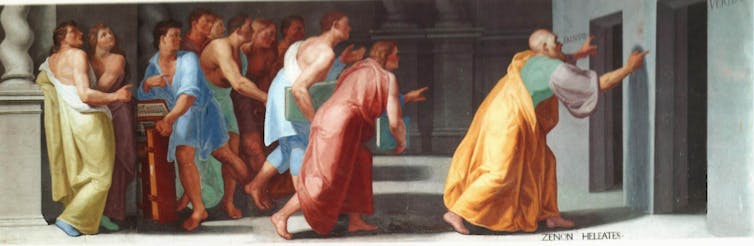
The Greek philosopher Zeno of Elea showing his followers the doors of Truth and Falsehood in a 16th century fresco at the El Escorial in Madrid. (El Escorial, Madrid)
But of course you can walk all the way to the end of the block and beyond — so Zeno’s deduction is absurd. His fallacy lies in removing time from the picture and considering only successive spatial configurations. His shrinking distances are matched by shrinking time intervals, both becoming small in parallel.
Zeno implicitly fixes the overall time available for the motion — just as he fixes the distance — and the paradox appears only because time was removed. Restore time, and the contradiction disappears.
Parmenides makes a similar mistake when claiming that events in the past and future — things that have happened or that will happen — exist. That assumption is the problem: it is equivalent to the conclusion he wants to reach. His reasoning is circular, ending by restating his assumption — only in a way that sounds different and profound.
Space-time models
An event is something that happens at a precise location and time. In Albert Einstein’s theories of relativity, space-time is a four-dimensional model describing all such occurrences: each point is a particular event, and the continuous sequence of events associated with an object forms its worldline — its path through space and time.
But events don’t exist; they happen. When physicists and philosophers speak of space-time as something that exists, they’re treating events as existent things — the same subtle fallacy at the root of 25 centuries of confusion.
It describes a three-dimensional universe filled with stars, planets and galaxies that exist. And in the course of that existence, the locations of every particle at every instance are individual space-time events. As the universe exists, the events that happen moment by moment trace out worldlines in four-dimensional space-time — a geometric representation of everything that happens during that course of existence; a useful model, though not an existent thing.
The resolution
Resolving Augustine’s paradox — that time is something we innately understand but cannot describe — is simple once the source of confusion is identified.
Events — things that happen or occur — are not things that exist. Each time you step into the river is a unique event. It happens in the course of your existence and the river’s. You and the river exist; the moment you step into it happens.
Philosophers have agonized over time-travel paradoxes for more than a century, yet the basic concept rests on the same subtle error — something science fiction writer H.G. Wells introduced in the opening of The Time Machine.
In presenting his idea, the Time Traveller glides from describing three-dimensional objects, to objects that exist, to moments along a worldline — and finally to treating the worldline as something that exists.
That final step is precisely the moment the map is mistaken for the territory. Once the worldline, or indeed space-time, is imagined to exist, what’s to stop us from imagining that a traveller could move throughout it?
Occurrence and existence are two fundamentally distinct aspects of time: each essential to understanding it fully, but never to be conflated with the other.
Speaking and thinking of occurrences as things that exist has been the root of our confusion about time for millennia. Now consider time in light of this distinction. Think about the existing things around you, the familiar time-travel stories and the physics of space-time itself.
Once you recognize ours as an existing three-dimensional universe, full of existing things, and that events happen each moment in the course of that cosmic existence — mapping to space-time without being reality — everything aligns. Augustine’s paradox dissolves: time is no longer mysterious once occurrence and existence are separated.
Your brain is currently expending about a fifth of your body’s energy, and almost none of that is being used for what you’re doing right now. Reading these words, feeling the weight of your body in a chair – all of this together barely changes the rate at which your brain consumes energy, perhaps by as little as 1%.
The other 99% is used on the activity the brain generates on its own: neurons (nerve cells) firing and signalling to each other regardless of whether you’re thinking hard, watching television, dreaming, or simply closing your eyes.
Even in the brain areas dedicated to vision, the visuals coming in through your eyes shape the activity of your neurons less than this internal ongoing action.
In a paper just published in Psychological Review, we argue that our imagination sculpts the images we see in our mind’s eye by carving into this background brain activity. In fact, imagination may have more to do with the brain activity it silences than with the activity it creates.
Imagining as seeing in reverse
Consider how “seeing” is understood to work. Light enters the eyes and sparks neural signals. These travel through a sequence of brain regions dedicated to vision, each building on the work of the last.
The earliest regions pick out simple features such as edges and lines. The next combine those into shapes. The ones after that recognise objects, and those at the top of the sequence assemble whole faces and scenes.
Neuroscientists call this “feedforward activity” – the gradual transformation of raw light into something you can name, whether it’s a dog, a friend, or both.
In brain science, the standard view is that visual imagination is this original seeing process run in reverse, from within your mind rather than from light entering your eyes.
So, when you hold the face of a friend in mind, you start with an abstract idea of them – a memory or a name, pulled from the filing cabinet of regions that sit beyond the visual system itself.
That idea travels back down through the visual sequence into the early visual areas, which serve as your brain’s workshop where a face would normally be reconstructed from its parts – the curve of a jawline, the specific shade of an eye. These downward signals are called “feedback activity”.
A signal through the static
However, prior research shows this feedback activity doesn’t drive visual neurons to fire in the same way as when you actually see something.
Even behind closed eyes, early visual brain areas keep producing shifting patterns of neural activity resembling those the brain uses to process real vision.
Imagination doesn’t need to build a face from scratch. The raw material is already there. In the internal rumblings of your visual areas, fragments of every face you know are drifting through at low volume. Your friend’s face, even now, is passing through in pieces, scattered and unrecognised. What imagining does is hold still the currents that would otherwise carry those pieces away.
All that’s needed is a small, targeted suppression of neurons that are pulled by brain activity in a different direction, and your friend’s face settles out of the noise, like a signal carving its way through static.
Steering the brain
In mice, artificially switching on as few as 14 neurons in a sensory brain region is enough for the animal to notice it and lick a sugar-water spout in response. This shows how small an intervention in the brain can be while still steering behaviour.
While we don’t know how many neurons are needed to steer internal activity into a conscious experience of imagination in humans, growing evidence shows the importance of dampening neural activity.
Other lines of evidence strengthen our theory, too. About one in 100 people have aphantasia, which means they can’t form mental images at all. One in 30 form these images so vividly they approach the intensity of images we actually see, known as hyperphantasia.
Research has found that people with weaker mental imagery have more excitable early visual areas, where neurons fire more readily on their own. This is consistent with a visual system whose spontaneous patterns are harder to hold in shape.
Taking all this together, the spontaneous activity reshaping hypothesis – our new theory that imagination carves images out of the steady stream of ongoing brain activity – explains why imagination usually feels weaker than sight. It also explains why we rarely lose track of which is which.
Visual perception arrives with a strength and regularity the brain’s own internal patterns don’t match. Imagination works with those patterns rather than against them, reshaping what is already there into something we can almost see.
As many people sit at the wheel of their car, they are certain they know what colour is. It’s the red traffic light in front of them, the garish yellow hatchback in the next lane, or the green verge banking to their right.
Colour, as many people understand it, is the property of a thing. That light is green. The sky is blue. But scientifically, that’s not quite true. No one can experience the exact same colour as you do. Colour is a perceptual experience created by our brains.
It’s the interaction between a material, light and the mind. The way a material absorbs and scatters light affects what reaches our eyes. And colour needs to be processed by the brain.
The shape of objects and the context in which you encounter them can also shape the way you perceive colour. If you’ve ever picked a paint colour that looked perfect in the shop but turned into something entirely difference once on your walls, you’ve already encountered this phenomenon.
This notion of colour as experience was recently shown in a study by researchers at the University of California, Berkeley, who used lasers to manipulate participants’ eyes into seeing a new colour – a blue-green they call olo.
To achieve this, the scientists used lasers to activate specific photoreceptor cells in the retina that detect green wavelengths of light, called M cones. We also have S and L cones, types of photoreceptors that detect short blue, and longer red wavelengths of light respectively. Everyone has slight variations in the number and sensitivity of these cones, so we each experience colour a little differently.
Outside the lab, the reflected light that comes into our eyes illuminates large areas of the retina, which stimulates multiple cone types. The wavelengths perceived by the M and L cones overlap by over 85%. This means that under natural conditions, the two are always activated together, but in varying degrees.
By targeting just the M cones, the scientists at Berkeley have in essence created a pure colour. Olo doesn’t have context or material conditions. It will look the same to different people.
But this isn’t the only example which shows the place of the brain in colour perception.
The most common type of red-green colour blindness, deuteranomaly, occurs when the M and L cones overlap more than they should. This reduces people’s ability to distinguish between colours in that range, without affecting sharpness or brightness.
Language may play a role in colour perception, influencing how easily or accurately we discriminate between colours, especially when languages differ in how they categorise or label colour distinctions. This highlights the gulf between an objective property and the processing of the brain.
The difference between the subjective experience of colour and the fixed, physical means of producing it means that most artists’ search for “pure” paint will fail. British artist Stuart Semple recently claimed he’d recreated olo in paint form. He called the paint yolo. But when people look at it, M and L cones will be activated at the same time. A “pure” paint is still impossible.
Semple’s Black 3.0, along with other ultra-black materials, is marketed as a “pure” black paint. It absorbs nearly all light, using a high concentration of light-absorbing pigments and a matte binder to minimise reflections. But instead of offering a pure colour, it removes colour altogether – delivering a universal experience of “black” by eliminating visual stimulus.
In truth, artists have known colour is a matter of perception for quite some time. The modernist artist Mark Rothko was notoriously meticulous about how his work was displayed. Rothko insisted that his work be hung low, with as little white wall visible as possible, in dim light.
He was shaping the experience of colour his work presented to the onlooker by controlling brightness, contrast and the surroundings. Rothko, like the scientists at Berkeley, recognised that colour is an interaction between material, light and observer. It is not just about manipulating what we don’t see, but about engineering what we do.
I have been running a public engagement programme, Transcending the Invisible, which brings together scientists and artists to explore scientific ideas through art. What I’ve been struck by most is that scientists and artists share this understanding of colour as experience.
The future of colour
Why do so many artists want to patent the blackest black, the bluest blue or the pinkest pink if they know that colour can’t be made “pure” with pigment?
Berkeley researcher Austin Roorda described having a “wow” experience at perceiving something entirely new when he saw olo.
We need to accept that colours like Semple’s yolo can create a similar wow feeling.
The work at Berkeley opens the door to a much more direct experience of colour than we’ve ever had before. Scientists in the future may map the photoreceptors and parts of the brain which process colour, allowing them to beam a range of direct and repeatable experiences into people’s brains.
It’s important to note that colour isn’t just sensory data but something that shapes how we feel, remember and connect to the world. Artists like Rothko, Van Gogh and Kandinsky had an innate understanding of that which scientists are only now starting to piece together.
The festive season can have a strange effect on our perception of time. Days blur together, hours stretch or vanish, and a sense of timelessness sets in. So, what better period to enjoy films that help us to reflect on time itself?
From mind-bending narratives to meditative explorations on time’s passage, these films are perfect for losing yourself – and finding new perspectives on time.
1. Citizen Kane (1941)
Orson Welles’ cinematic masterpiece doesn’t just tell the story of publishing tycoon Charles Foster Kane, it fragments it. It begins with Kane’s death and enigmatic final word, “Rosebud”. The film then unfolds in flashbacks narrated by those who knew him as they seek to discover the word’s meaning.
Each perspective adds a layer to his life while challenging the idea of a singular truth. Welles uses time as a puzzle, showing how memory and perception overlap to shape our understanding of the past.
Citizen Kane trailer.
2. Memento (2000)
Christopher Nolan’s breakthrough film has a reverse chronological structure, intercut with black-and-white sequences moving forward in time. The story is told through a series of scenes that move backwards while the protagonist, Leonard Shelby (Guy Pearce), moves forward with no short-term memory.
The film opens with the end so we know what happens but we don’t know why or how we got there. Each scene ends where the previous scene began, creating a sense of disorientation that mirrors Leonard’s condition.
3. The Clock (2010)
Christian Marclay’s 24-hour video installation turns time itself into art. It includes a stunning montage of scenes from film and television that feature clocks, timepieces or people waiting. More than 12,000 clips are meticulously assembled to create an artwork that itself functions as a clock.
The film’s presentation is synchronised with the local time, resulting in the time shown in any scene being the actual time. This makes viewers acutely aware of time’s passage while simultaneously losing themselves in a hypnotic stream of cinematic moments.
Cinematic and actual time run parallel in a 24-hour montage in The Clock.
4. High Noon (1952)
This landmark Western film collapses real time with screen time. Marshal Will Kane (Gary Cooper) is preparing to retire and leave town with his new wife, Amy (Grace Kelly). But he receives news that Frank Miller, a criminal he sent to prison, has been pardoned and is arriving on the noon train seeking revenge.
Despite pleas from his wife and townspeople to flee, Kane decides to stay and face Miller and his gang. He then finds himself increasingly isolated as the town abandons him. The film unfolds in approximate real time (85 minutes) between 10.40am and noon.
5. The Killing (1956)
Stanley Kubrick’s non-linear “one-last job” heist movie fragments time to brilliant effect. The narrative unfolds in a series of progressive flashbacks and even “flash sideways”, in which the actions and events are repeated from different characters’ points of view.
The studio hated it and asked him to cut it in a conventional fashion. But Kubrick abandoned the re-edit and returned the film to its original structure. As he told film critic Alexander Walker in 1971: “It was the handling of time that may have made this more than just a good crime film.”
The Killing’s official trailer from 1956.
6. Donnie Darko (2001)
This cult favourite merges teenage alienation and mental health with metaphysical time travel. Jake Gyllenhaal’s Donnie is haunted by visions and drawn into a “tangent universe” where time corrupts and loops back on itself. The film’s complex temporal structure involves parallel universes, predestination and sacrifice.
Its ambiguous ending leaves viewers debating whether Donnie’s actions were heroic sacrifice or delusion, making time itself an unreliable narrator.
7. Groundhog Day (1993)
Bill Murray’s cynical weatherman wakes up to the same day – again and again. As he relives February 1’s Groundhog Day in an endless loop, he is able to improve himself. He eventually evolves from selfishness and cynicism to empathy and kindness.
Interestingly, the film doesn’t reflect on why its protagonist relives the same day over and over again, and just accepts it.
8. Run Lola Run (1998)
This German-language thriller tells the same story three times, each with a different outcome. It presents alternative scenarios of Lola’s (Franka Potente) attempt to save her boyfriend’s life.
The film explores chaos theory and the butterfly effect through kinetic storytelling, with tiny variations in Lola’s choices rippling into dramatically different futures. The film’s use of different media, including animation and still photography, for different temporal states adds visual sophistication to its exploration of chance and choice.
9. Arrival (2016)
Time is not linear, at least not for the alien visitors in Denis Villeneuve’s sci-fi drama. As linguist Louise Banks (Amy Adams) learns to decode their language, she begins to experience time as they do – all at once.
The “Heptapod” language requires understanding the entire sentence before beginning it. This serves as a metaphor for how we might experience time if we could see it all at the same time.
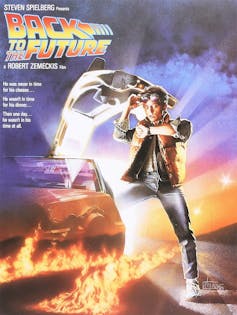
Few films play with the concept of time as joyfully as Robert Zemeckis’s 1980s classic, and no list of this type would be complete without it. Marty McFly (Michael J. Fox) adventures between the 1980s and 1950s using a DeLorean car retrofitted as a time machine.
It explores time, space and consequence, as Marty races to ensure his teenage parents fall in love to restore the future. It also spawned two popular sequels.
All of these films remind us that time isn’t just a backdrop. It’s a force that shapes our lives, memories and stories. As you sink into the cosy limbo of the season, let these cinematic journeys through time inspire reflection on your own.
Time feels like the most basic feature of reality. Seconds tick, days pass and everything from planetary motion to human memory seems to unfold along a single, irreversible direction. We are born and we die, in exactly that order. We plan our lives around time, measure it obsessively and experience it as an unbroken flow from past to future. It feels so obvious that time moves forward that questioning it can seem almost pointless.
And yet, for more than a century, physics has struggled to say what time actually is. This struggle is not philosophical nitpicking. It sits at the heart of some of the deepest problems in science.
Modern physics relies on different, but equally important, frameworks. One is Albert Einstein’s theory of general relativity, which describes the gravity and motion of large objects such as planets. Another is quantum mechanics, which rules the microcosmos of atoms and particles. And on an even larger scale, the standard model of cosmology describes the birth and evolution of the universe as a whole. All rely on time, yet they treat it in incompatible ways.
When physicists try to combine these theories into a single framework, time often behaves in unexpected and troubling ways. Sometimes it stretches. Sometimes it slows. Sometimes it disappears entirely.
The Insights section is committed to high-quality longform journalism. Our editors work with academics from many different backgrounds who are tackling a wide range of societal and scientific challenges.
Einstein’s theory of relativity was, in fact, the first major blow to our everyday intuition about time. Time, Einstein showed, is not universal. It runs at different speeds depending on gravity and motion. Two observers moving relative to one another will disagree about which events happened at the same time. Time became something elastic, woven together with space into a four-dimensional fabric called spacetime.
Quantum mechanics made things even stranger. In quantum theory, time is not something the theory explains. It is simply assumed. The equations of quantum mechanics describe how systems evolve with respect to time, but time itself remains an external parameter, a background clock that sits outside the theory.
This mismatch becomes acute when physicists try to describe gravity at the quantum level, which is crucial for developing the much coveted theory of everything – which links the main fundamental theories. But in many attempts to create such a theory, time vanishes as a parameter from the fundamental equations altogether. The universe appears frozen, described by equations that make no reference to change.
This puzzle is known as the problem of time, and it remains one of the most persistent obstacles to a unified theory of physics. Despite enormous progress in cosmology and particle physics, we still lack a clear explanation for why time flows at all.
Now a relatively new approach to physics, building on a mathematical framework called information theory, developed by Claude Shannon in the 1940s, has started coming up with surprising answers.
You can listen to more articles from The Conversation, narrated by Noa, here.
Entropy and the arrow of time
When physicists try to explain the direction of time, they often turn to a concept called entropy. The second law of thermodynamics states that disorder tends to increase. A glass can fall and shatter into a mess, but the shards never spontaneously leap back together. This asymmetry between past and future is often identified with the arrow of time.
This idea has been enormously influential. It explains why many processes are irreversible, including why we remember the past but not the future. If the universe started in a state of low entropy, and is getting messier as it evolves, that appears to explain why time moves forward. But entropy does not fully solve the problem of time.
For one thing, the fundamental quantum mechanical equations of physics do not distinguish between past and future. The arrow of time emerges only when we consider large numbers of particles and statistical behaviour. This also raises a deeper question: why did the universe start in such a low-entropy state to begin with? Statistically, there are more ways for a universe to have high entropy than low entropy, just as there are more ways for a room to be messy than tidy. So why would it start in a state that is so improbable?
The information revolution
Over the past few decades, a quiet but far-reaching revolution has taken place in physics. Information, once treated as an abstract bookkeeping tool used to track states or probabilities, has increasingly been recognised as a physical quantity in its own right, just like matter or radiation. While entropy measures how many microscopic states are possible, information measures how physical interactions limit and record those possibilities.
This shift did not happen overnight. It emerged gradually, driven by puzzles at the intersection of thermodynamics, quantum mechanics and gravity, where treating information as merely mathematical began to produce contradictions.
One of the earliest cracks appeared in black hole physics. When Stephen Hawking showed that black holes emit thermal radiation, it raised a disturbing possibility: information about whatever falls into a black hole might be permanently lost as heat. That conclusion conflicted with quantum mechanics, which demands that the entirety of information be preserved.
Resolving this tension forced physicists to confront a deeper truth. Information is not optional. If we want a full description of the universe that includes quantum mechanics, information cannot simply disappear without undermining the foundations of physics. This realisation had profound consequences. It became clear that information has thermodynamic cost, that erasing it dissipates energy, and that storing it requires physical resources.
In parallel, surprising connections emerged between gravity and thermodynamics. It was shown that Einstein’s equations can be derived from thermodynamic principles that link spacetime geometry directly to entropy and information. In this view, gravity doesn’t behave exactly like a fundamental force.
Instead, gravity appears to be what physicists call “emergent” – a phenomenon describing something that’s greater than the sum of its parts, arising from more fundamental constituents. Take temperature. We can all feel it, but on a fundamental level, a single particle can’t have temperature. It’s not a fundamental feature. Instead it only emerges as a result of many molecules moving collectively.
Similarly, gravity can be described as an emergent phenomenon, arising from statistical processes. Some physicists have even suggested that gravity itself may emerge from information, reflecting how information is distributed, encoded and processed.
These ideas invite a radical shift in perspective. Instead of treating spacetime as primary, and information as something that lives inside it, information may be the more fundamental ingredient from which spacetime itself emerges. Building on this research, my colleagues and I have explored a framework in which spacetime itself acts as a storage medium for information – and it has important consequences for how we view time.
In this approach, spacetime is not perfectly smooth, as relativity suggests, but composed of discrete elements, each with a finite capacity to record quantum information from passing particles and fields. These elements are not bits in the digital sense, but physical carriers of quantum information, capable of retaining memory of past interactions.
A useful way to picture them is to think of spacetime like a material made of tiny, memory-bearing cells. Just as a crystal lattice can store defects that appeared earlier in time, these microscopic spacetime elements can retain traces of the interactions that have passed through them. They are not particles in the usual sense described by the standard model of particle physics, but a more fundamental layer of physical structure that particle physics operates on rather than explains.
This has an important implication. If spacetime records information, then its present state reflects not only what exists now, but everything that has happened before. Regions that have experienced more interactions carry a different imprint of information than regions that have experienced fewer. The universe, in this view, does not merely evolve according to timeless laws applied to changing states. It remembers.
A recording cosmos
This memory is not metaphorical. Every physical interaction leaves an informational trace. Although the basic equations of quantum mechanics can be run forwards or backwards in time, real interactions never happen in isolation. They inevitably involve surroundings, leak information outward and leave lasting records of what has occurred. Once this information has spread into the wider environment, recovering it would require undoing not just a single event, but every physical change it caused along the way. In practice, that is impossible.
This is why information cannot be erased and broken cups do not reassemble. But the implication runs deeper. Each interaction writes something permanent into the structure of the universe, whether at the scale of atoms colliding or galaxies forming.
Geometry and information turn out to be deeply connected in this view. In our work, we have showed that how spacetime curves depends not only on mass and energy, as Einstein taught us, but also on how quantum information, particularly entanglement, is distributed. Entanglement is a quantum process that mysteriously links particles in distant regions of space – it enables them to share information despite the distance. And these informational links contribute to the effective geometry experienced by matter and radiation.
From this perspective, spacetime geometry is not just a response to what exists at a given moment, but to what has happened. Regions that have recorded many interactions tend, on average, to behave as if they curve more strongly, have stronger gravity, than regions that have recorded fewer.
This reframing subtly changes the role of spacetime. Instead of being a neutral arena in which events unfold, spacetime becomes an active participant. It stores information, constrains future dynamics and shapes how new interactions can occur. This naturally raises a deeper question. If spacetime records information, could time emerge from this recording process rather than being assumed from the start?
Time arising from information
Recently, we extended this informational perspective to time itself. Rather than treating time as a fundamental background parameter, we showed that temporal order emerges from irreversible information imprinting. In this view, time is not something added to physics by hand. It arises because information is written in physical processes and, under the known laws of thermodynamics and quantum physics, cannot be globally unwritten again. The idea is simple but far-reaching.
Every interaction, such as two particles crashing, writes information into the universe. These imprints accumulate. Because they cannot be erased, they define a natural ordering of events. Earlier states are those with fewer informational records. Later states are those with more.
Quantum equations do not prefer a direction of time, but the process of information spreading does. Once information has been spread out, there is no physical path back to a state in which it was localised. Temporal order is therefore anchored in this irreversibility, not in the equations themselves.
Time, in this view, is not something that exists independently of physical processes. It is the cumulative record of what has happened. Each interaction adds a new entry, and the arrow of time reflects the fact that this record only grows.
The future differs from the past because the universe contains more information about the past than it ever can about the future. This explains why time has a direction without relying on special, low-entropy initial conditions or purely statistical arguments. As long as interactions occur and information is irreversibly recorded, time advances.
Interestingly, this accumulated imprint of information may have observable consequences. At galactic scales, the residual information imprint behaves like an additional gravitational component, shaping how galaxies rotate without invoking new particles. Indeed, the unknown substance called dark matter was introduced to explain why galaxies and galaxy clusters rotate faster than their visible mass alone would allow.
In the informational picture, this extra gravitational pull does not come from invisible dark matter, but from the fact that spacetime itself has recorded a long history of interactions. Regions that have accumulated more informational imprints respond more strongly to motion and curvature, effectively boosting their gravity. Stars orbit faster not because more mass is present, but because the spacetime they move through carries a heavier informational memory of past interactions.
From this viewpoint, dark matter, dark energy and the arrow of time may all arise from a single underlying process: the irreversible accumulation of information.
Testing time
But could we ever test this theory? Ideas about time are often accused of being philosophical rather than scientific. Because time is so deeply woven into how we describe change, it is easy to assume that any attempt to rethink it must remain abstract. An informational approach, however, makes concrete predictions and connects directly to systems we can observe, model and in some cases experimentally probe.
Black holes provide a natural testing ground, as they seems to suggest information is erased. In the informational framework, this conflict is resolved by recognising that information is not destroyed but imprinted into spacetime before crossing the horizon. The black hole records it.
This has an important implication for time. As matter falls toward a black hole, interactions intensify and information imprinting accelerates. Time continues to advance locally because information continues to be written, even as classical notions of space and time break down near the horizon and appear to slow or freeze for distant observers.
As the black hole evaporates through Hawking radiation, the accumulated informational record does not vanish. Instead, it affects how radiation is emitted. The radiation should carry subtle signs that reflect the black hole’s history. In other words, the outgoing radiation is not perfectly random. Its structure is shaped by the information previously recorded in spacetime. Detecting such signs remains beyond current technology, but they provide a clear target for future theoretical and observational work.
The same principles can be explored in much smaller, controlled systems. In laboratory experiments with quantum computers, qubits (the quantum computer equivalent of bits) can be treated as finite-capacity information cells, just like the spacetime ones. Researchers have shown that even when the underlying quantum equations are reversible, the way information is written, spread and retrieved can generate an effective arrow of time in the lab. These experiments allow physicists to test how information storage limits affect reversibility, without needing cosmological or astrophysical systems.
Extensions of the same framework suggest that informational imprinting is not limited to gravity. It may play a role across all fundamental forces of nature, including electromagnetism and the nuclear forces. If this is correct, then time’s arrow should ultimately be traceable to how all interactions record information, not just gravitational ones. Testing this would involve looking for limits on reversibility or information recovery across different physical processes.
Taken together, these examples show that informational time is not an abstract reinterpretation. It links black holes, quantum experiments and fundamental interactions through a shared physical mechanism, one that can be explored, constrained and potentially falsified as our experimental reach continues to grow.
What time really is
Ideas about information do not replace relativity or quantum mechanics. In everyday conditions, informational time closely tracks the time measured by clocks. For most practical purposes, the familiar picture of time works extremely well. The difference appears in regimes where conventional descriptions struggle.
Near black hole horizons or during the earliest moments of the universe, the usual notion of time as a smooth, external coordinate becomes ambiguous. Informational time, by contrast, remains well defined as long as interactions occur and information is irreversibly recorded.
All this may leave you wondering what time really is. This shift reframes the longstanding debate. The question is no longer whether time must be assumed as a fundamental ingredient of the universe, but whether it reflects a deeper underlying process.
In this view, the arrow of time can emerge naturally from physical interactions that record information and cannot be undone. Time, then, is not a mysterious background parameter standing apart from physics. It is something the universe generates internally through its own dynamics. It is not ultimately a fundamental part of reality, but emerges from more basic constituents such as information.
Whether this framework turns out to be a final answer or a stepping stone remains to be seen. Like many ideas in fundamental physics, it will stand or fall based on how well it connects theory to observation. But it already suggests a striking change in perspective.
The universe does not simply exist in time. Time is something the universe continuously writes into itself.
To hear about new Insights articles, join the hundreds of thousands of people who value The Conversation’s evidence-based news. Subscribe to our newsletter.










.jpg)